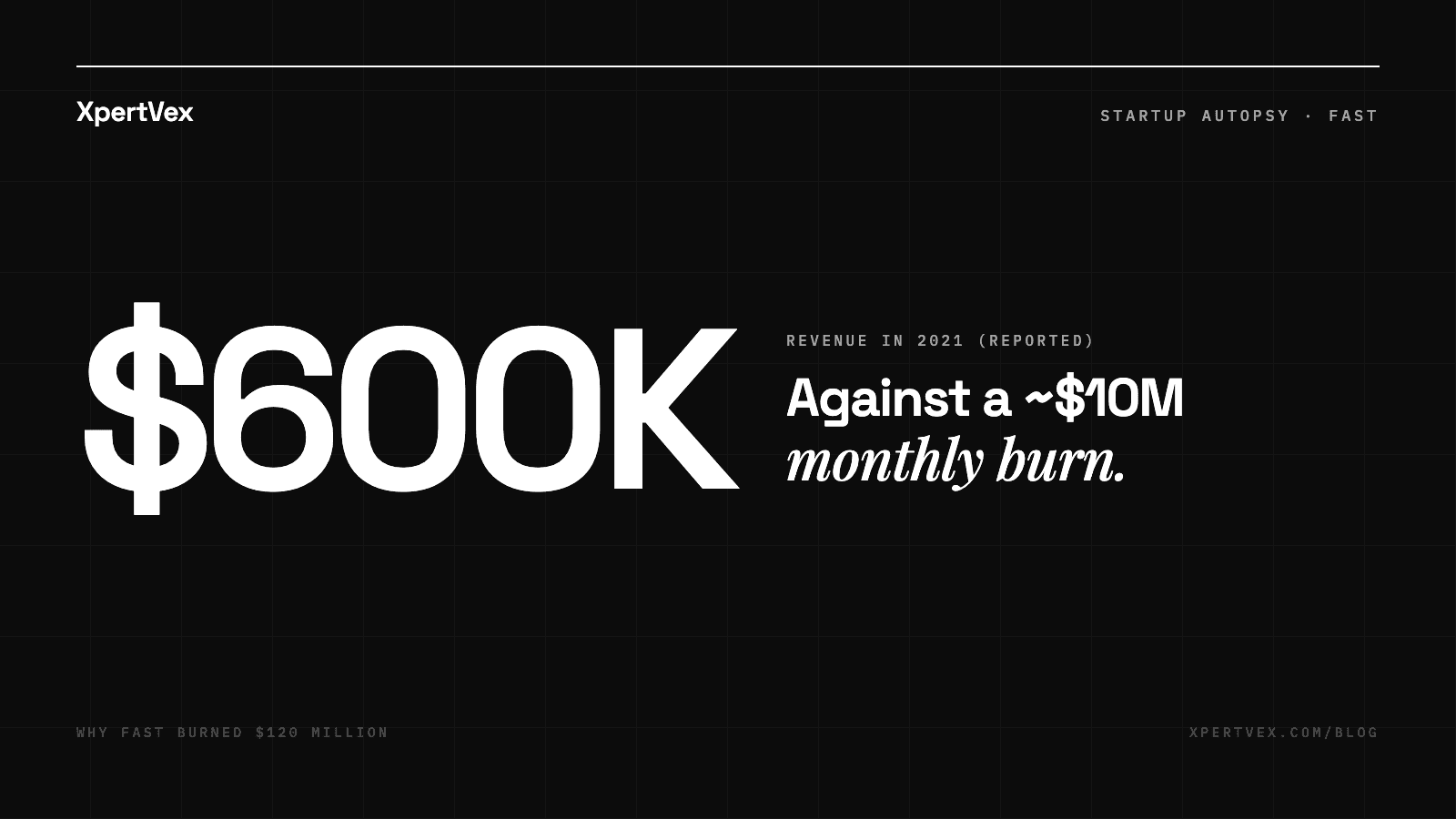
Fast had everything a 2021 startup was supposed to have. It had a famous lead investor, a slick product demo, a loud founder on social media, and a hiring plan that doubled the team every few months. What it didn't have was revenue. According to reporting by The Information, Fast made about $600,000 in 2021, while burning about $10 million a month.
~200x
BURN VS. REVENUE
At a reported ~$10M a month, a year of spending is roughly $120M — about 200 times Fast's reported 2021 revenue of ~$600K.
The timeline
2019 — Domm Holland and Allison Barr Allen found Fast to make online checkout a single click, across any store.
January 2021 — Fast raises a $102 million Series B led by Stripe and Addition, bringing total funding to about $124 million. The team has grown from two co-founders to about 90 people and plans to pass 200 by year-end.
2021 — Fast reportedly generates about $600,000 in revenue for the year.
Early 2022 — Fast tries to raise again at a valuation above $1 billion. Investors pass. It explores a sale and plans to cut half its staff.
April 5, 2022 — Fast announces it is shutting down. Fast Checkout is switched off on April 15. Affirm offers jobs to most of its engineers.
Fast in 2021, as reported
US$ millions. Revenue figure from The Information; burn is the reported monthly rate.
Vanity growth vs. real growth
Fast's dashboard probably looked great. Merchants were signing up — it announced new partners as late as March 2022. The brand was everywhere. Headcount was climbing. But each of those numbers measured activity, not value.
The metric that mattered was simple: how many purchases went through the Fast button, and how much did Fast earn on each one? A checkout company earns a small fee per transaction. To cover a $10 million monthly burn on a fee of a few percent, shoppers need to push hundreds of millions of dollars a month through your button. Fast's reported revenue suggests it was nowhere near that.
Vanity metrics grow when you spend money. Real metrics grow when customers spend money. If a number goes up every time you raise a round, it's probably the first kind.
Why the unit economics never worked
One-click checkout is a two-sided network
A shopper only benefits from Fast if their favourite stores offer it. A store only benefits if its shoppers already have a Fast account. That chicken-and-egg problem is solvable, but it's slow and expensive. And Fast wasn't starting from zero against nobody: Apple Pay, PayPal and Shop Pay already had saved cards in millions of browsers and phones.
Merchants signed, shoppers didn't follow
Signing a merchant is a sales win. It isn't revenue until shoppers choose your button over the ones they already use. Fast kept adding logos to its partner list. It didn't prove those logos turned into checkout volume.
Spending was set by the funding, not by the business
A $102 million round invites a hiring plan to match. When spending is sized to the round rather than to proven demand, a bad month for fundraising becomes an existential one. That's what happened in early 2022, when the market cooled and Fast's next round didn't come together.
The questions Fast should have answered first
Every one of these can be answered before raising a big round:
What's the realistic volume per merchant? Pilot with ten merchants and measure the share of their checkouts that actually use your button.
What's the take rate after costs? Your fee minus the card networks and processor costs is your real gross margin per transaction.
How long until a merchant pays back what it cost to win? If you need a sales team to sign each merchant, that cost has a payback period. Know it.
Who already owns the habit? List every wallet and saved-card option your buyers use today. Your product has to beat all of them, not just the old checkout form.
What does the business look like at 1/10th of the plan? If it doesn't survive that, the plan is a bet on the funding market, not the product.
The real lesson
Fast is often told as a story about a reckless founder. The more useful version is about a market that was smaller and harder to win than the funding implied. One-click checkout is a real need, but the payment wallets already in shoppers' pockets were solving most of it. A sober look at market size, competitors and pricing power would have shown that before the $102 million was raised, let alone spent.
If you're about to raise on traction, check that your traction is volume and revenue, not sign-ups and headlines. Our guide to growth-at-all-costs vs. capital efficiency goes deeper on the numbers investors now ask for.
Audit the market before you raise
An XpertVex report sizes your market, profiles the competitors and their pricing, and scores financial viability alongside market fit, technical feasibility and competition, on a 0–100 scale. For an idea like Fast's, the competitor section alone — who already has the shopper's saved card, and what they charge — is the conversation you want to have before you build a hiring plan.