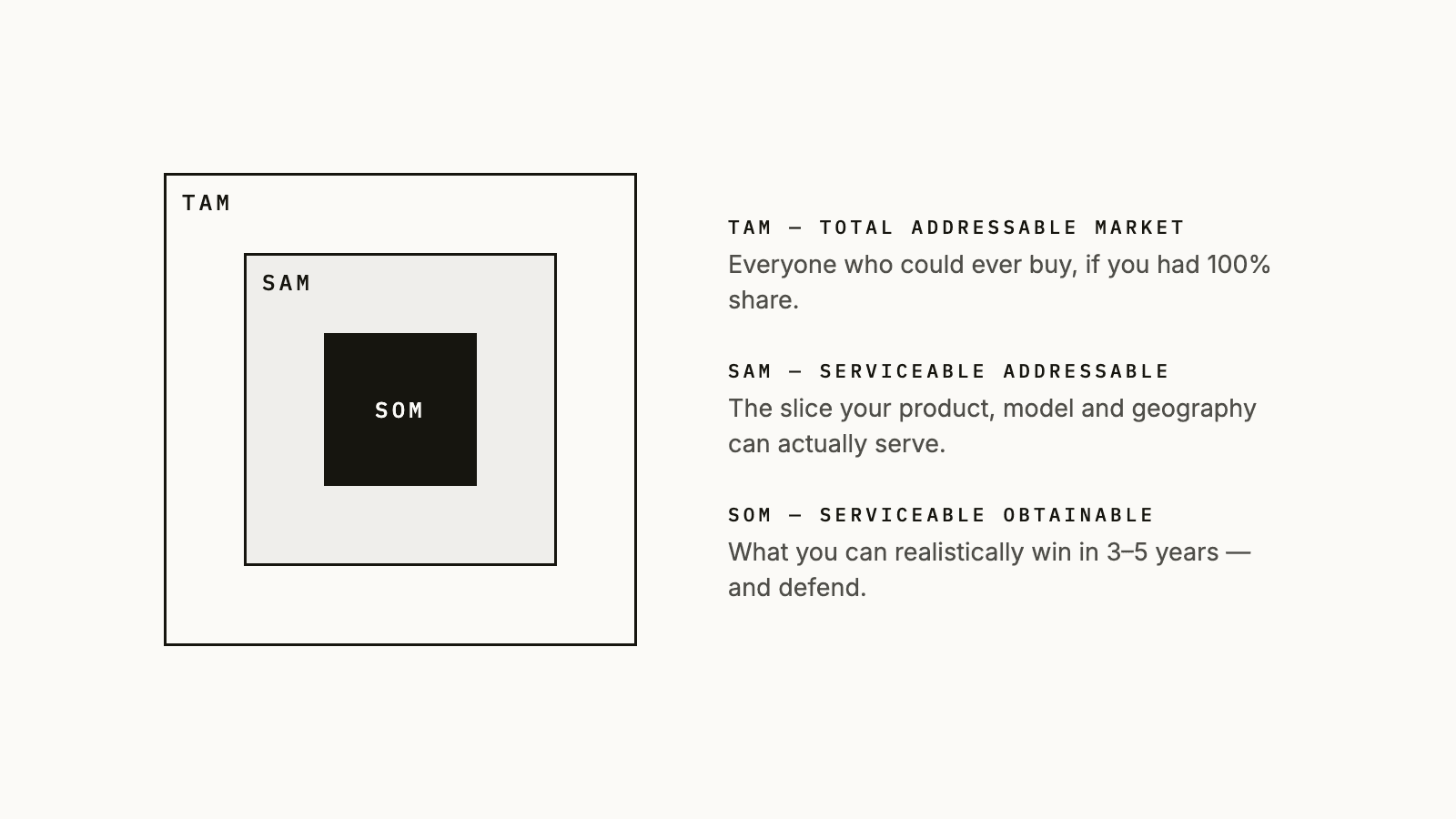
1. The Concentric Circles of Scale
TL;DR > TAM is your ultimate vision. SAM is your realistic target. SOM is your go-to-market execution.
When pitching your startup, claiming a "$1 Trillion Market" destroys your credibility. You must break your market down into realistic, achievable segments using TAM, SAM, and SOM.
1% to 5%
Realistic SOM
A highly successful early-stage startup typically captures 1% to 5% of their Serviceable Obtainable Market (SOM) in their first few years.
2. The Definitions
- TAM (Total Addressable Market): The total global demand for your product if 100% of the world bought it. (e.g., Every restaurant on Earth).
- SAM (Serviceable Available Market): The segment of the TAM targeted by your specific product and geographic reach. (e.g., English-speaking fast-casual restaurants in the US).
- SOM (Serviceable Obtainable Market): The realistic portion of the SAM you can capture in the next 1-3 years given your current resources and competition. (e.g., Fast-casual restaurants in New York that currently use outdated legacy POS systems).
The TAM / SAM / SOM Breakdown
How a massive theoretical market translates to actual capture.
3. Why It Matters
Your SOM proves you have a realistic go-to-market strategy. Your TAM proves the business is worth funding.