Pebble didn't fail for lack of customers. It practically invented the modern smartwatch, broke Kickstarter's funding record twice, and sold more than a million watches by the end of 2014. Then the biggest consumer-electronics companies in the world decided smartwatches were a category worth owning. Within two years, Pebble was gone.
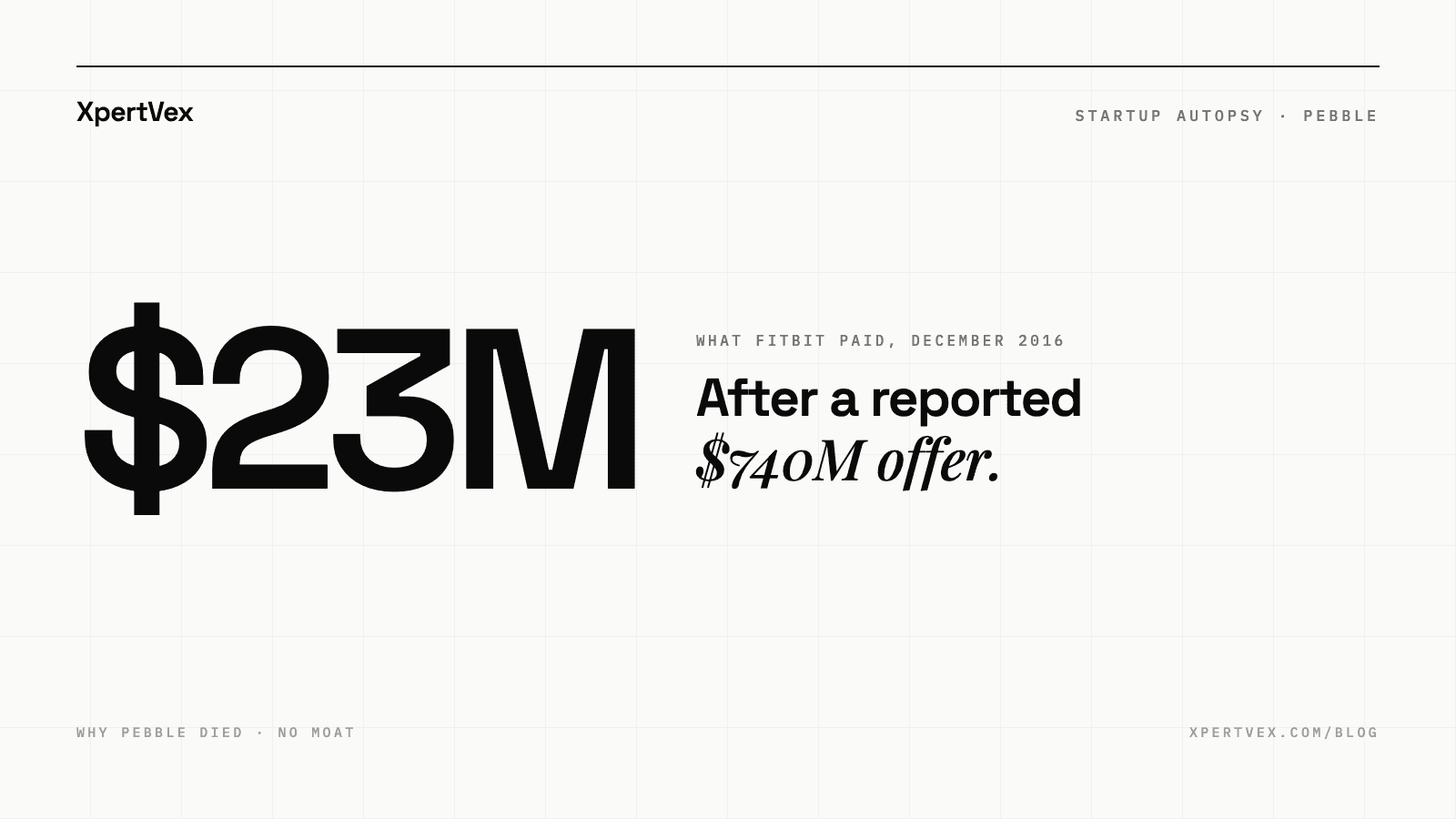
$740M → $23M
A REPORTED OFFER VS. THE FINAL SALE
Citizen reportedly offered $740 million for Pebble in 2015. In December 2016, Fitbit bought its software and IP for about $23 million.
The timeline
April 2012 — Pebble's first Kickstarter campaign hits its $100,000 goal in two hours. It closes at $10.27 million from 68,929 backers, a record at the time.
January 2013 — The first watches ship.
December 2014 — Pebble passes one million watches sold.
February–March 2015 — The Pebble Time campaign raises $20.34 million from 78,471 backers, a new Kickstarter record.
April 2015 — Apple Watch goes on sale. Citizen reportedly offers $740 million for Pebble that year; Pebble declines.
March 2016 — Pebble lays off 40 of its 160 employees, citing a difficult fundraising environment. Intel reportedly offers $70 million; Pebble declines again.
December 2016 — Pebble files for insolvency. Fitbit buys its software and intellectual property for about $23 million. The hardware, inventory and debts are not part of the deal, and the debts reportedly exceed the price.
What Pebble was worth to buyers
US$ millions. Citizen's 2015 offer as reported; Fitbit's 2016 price per its annual report.
Demand was never the problem
It's tempting to file Pebble under "no market need". That would be wrong. Two record-breaking campaigns and a million watches in under two years is strong demand by any standard. Pebble proved the market.
That's exactly what made it vulnerable. Once a startup proves a market is real, every larger company with an adjacent product gets a free answer to the question "should we build this?" Pebble validated the smartwatch for Apple, Samsung, Google's Android Wear partners and Fitbit — and none of them needed a Kickstarter to fund their version.
Validation answers "do people want this?" A moat answers "why will they keep buying it from you once someone bigger sells it too?" You need both.
What Pebble had, and why it wasn't enough
Pebble's real advantages were genuine. Long battery life from its e-paper display. A low price. Notifications that just worked. A passionate developer community and an app store. But look at each one through a competitor's eyes:
Battery life and price — engineering trade-offs, not secrets. A rival can choose the same trade-offs at any time.
Notifications — the phone maker controls them. Apple decides what third-party watches can do on an iPhone, and its own watch gets the deepest access.
The app store — valuable, but small. Developers follow users, and the bigger platforms had far more users.
The community — loyal, but loyalty rarely survives when a rival is better integrated with the phone already in your pocket.
None of those were moats. They were head starts. And head starts shrink every month.
The "clone in an afternoon" test
Before you build, run your idea through this test. Imagine the biggest company in your space decides to copy you. What stops them?
Network effects — does your product get better for each user as more people use it? Marketplaces and messaging apps have this. A standalone gadget usually doesn't.
Switching costs — would leaving you cost customers data, workflows, integrations or retraining? If they can switch in a weekend, you have no lock-in.
Proprietary data or access — do you have data, partnerships or regulatory approvals a newcomer can't buy quickly?
Distribution — do you reach customers more cheaply than the giant? Remember they already own the shelf, the app store or the phone.
Focus — is your market too small or too specific for a big company to bother with? That's a real moat, but only if you size the business to match it.
If you can't put a confident tick next to at least one, your strategy depends on the big players staying away. Write that down as a threat in your SWOT analysis, and make a plan for the day it happens.
The coda: a smaller Pebble, built to last
The story has an unusual epilogue. In January 2025, Google — which had acquired Pebble's software through its purchase of Fitbit — open-sourced PebbleOS. Founder Eric Migicovsky started Core Devices, recovered the Pebble trademark, and began selling new watches: the Pebble 2 Duo at $149 and the Pebble Time 2 at $225. He has described the new company as self-funded, with no outside investors.
That's the right shape for a business without a moat: small, focused on loyal fans, and not trying to beat Apple at Apple's game. The original Pebble raised and grew like a company that expected to own a category. Its moat could only support a niche.
Find your moat before your rivals find you
Every XpertVex report includes competitor profiles — what each rival offers, how they price it, and where they're weak — plus a full SWOT and a 0–100 score where competition is one of the four dimensions. If the biggest threat to your idea is "a giant could build this", you'll see it written down before you spend a year finding out.